The sponsor team had expected a slow start in Europe, but they weren’t prepared for how fragmented the process had become. They spent two weeks piecing together epidemiology, investigator qualifications, site capacity, and regulatory expectations across multiple registries. Nothing matched. Nothing aligned. By the end, they still couldn’t answer the most basic feasibility question: where can this study actually be conducted?
That moment of uncertainty is no longer unusual. It is increasingly common in Western regions where operational instability and data fragmentation complicate even early planning. And it is precisely the moment where Korea is beginning to stand apart.
A Global Shift in Clinical Trial Activity
EFPIA’s recent analysis paints a stark picture. Europe, once a stable anchor for global research, is losing ground. Over the last decade, its share of global commercial clinical trials dropped from 22% to 12%. Oncology enrollment fell more than one-third behind the United States. Phase 1 activity declined. Rare disease trial starts dropped nearly 20%. And regulatory transitions under CTR and IVDR created wide variability between countries.
Meanwhile, Asia is accelerating. Korea maintained one of the world’s most stable IND pipelines, with annual MFDS approvals ranging from 628 to 842 studies over the last decade. Activity peaked in 2021 and remained high through 2024, with 747 approvals, half of which were multinational. This consistency is increasingly important as global sponsors prioritize predictable environments over geographic legacy.
Korea is one of the few countries that combines Western quality with Asian operational efficiency, and the industry is taking notice.
Korea’s Clinical Trial System Is Quietly Becoming One of the Best in the World
Korea’s rise is visible not just in rankings, but in the reliability of its entire ecosystem. Key National statistics and global benchmarking illustrate an infrastructure built for global competitiveness:
- Seoul now ranks as the second city worldwide for industry-sponsored clinical trials, and Korea is Asia’s second most active country for multinational clinical trials.
- Ministry of Food and Drug Safety (MFDS) IND reviews average about 30 working days, among the fastest globally.
- Major academic IRBs complete reviews in roughly three weeks.
- Korea has maintained zero FDA BIMO OAI findings for more than fifteen years.
- More than 200 MFDS-designated clinical trial institutions operate nationwide.
Korea’s nationwide health insurance system, covering nearly the entire population, provides consistent medical histories and reliable follow-up. Its investigator density is among the highest in Asia, supported by more than 15,000 research professionals. Oncology remains Korea’s dominant research area, representing 37% of all IND approvals in 2024, supported by some of the most advanced oncology, neurology, and rare disease centers in the region. ~5% of GDP invested in R&D, Korea maintains one of the strongest innovation ecosystems in the world.
The only persistent challenge was the fragmentation of information across institutions. Investigator data lived in one place. Epidemiology in another. Vendor and site infrastructure in separate systems. Regulatory information in yet another.
KoNECT resolved this at the structural level.
K-CThub: A Unified National Portal Built for a Fragmenting Global Environment
K-CThub is Korea’s first national platform that consolidates every major component of trial planning into a single, structured system. Previously, sponsors needed to gather information from more than two hundred MFDS-designated institutions, separate investigator databases, and disparate epidemiologic and regulatory sources. K-CThub resolves this by offering one access point to the full landscape of Korea’s clinical research ecosystem.
The platform provides detailed information across all pillars of trial startup: investigator profiles; clinical trial site capabilities; service providers; MFDS regulatory requirements; epidemiology data; and links to related national resources. Its Service Provider section includes profiles of clinical and non-clinical CROs, DCT solution providers, laboratories, and specialized vendors, helping sponsors identify collaboration partners and evaluate operational strategies with clarity.
By organizing these datasets into a unified structure, K-CThub gives sponsors a comprehensive view of the institutions, professionals, and services that support clinical development in Korea, enabling faster, more confident decision-making at the earliest stages of study planning.
The platform goes further by incorporating AI trained on Korea’s clinical trial resource data, which includes thousands of certified investigators, high-volume tertiary hospitals, and disease prevalence patterns captured across a population with 99.6% insurance coverage. Through its integration with PubMed, the platform’s AI search feature can draw from more than 35 million scientific publications, allowing users to reference relevant literature while conducting AI-assisted queries.
This level of structural integration is exceptionally rare. In many regions, clinical trial information is distributed across multiple institutions and registries, requiring sponsors to assemble feasibility data manually. K-CThub addresses this challenge by offering a unified, nationally supported system where regulatory guidance, site and investigator information, epidemiologic data, and service provider resources are centrally accessible. This creates an environment where feasibility and early decision-making can be conducted with a level of coherence that is difficult to achieve in most markets.
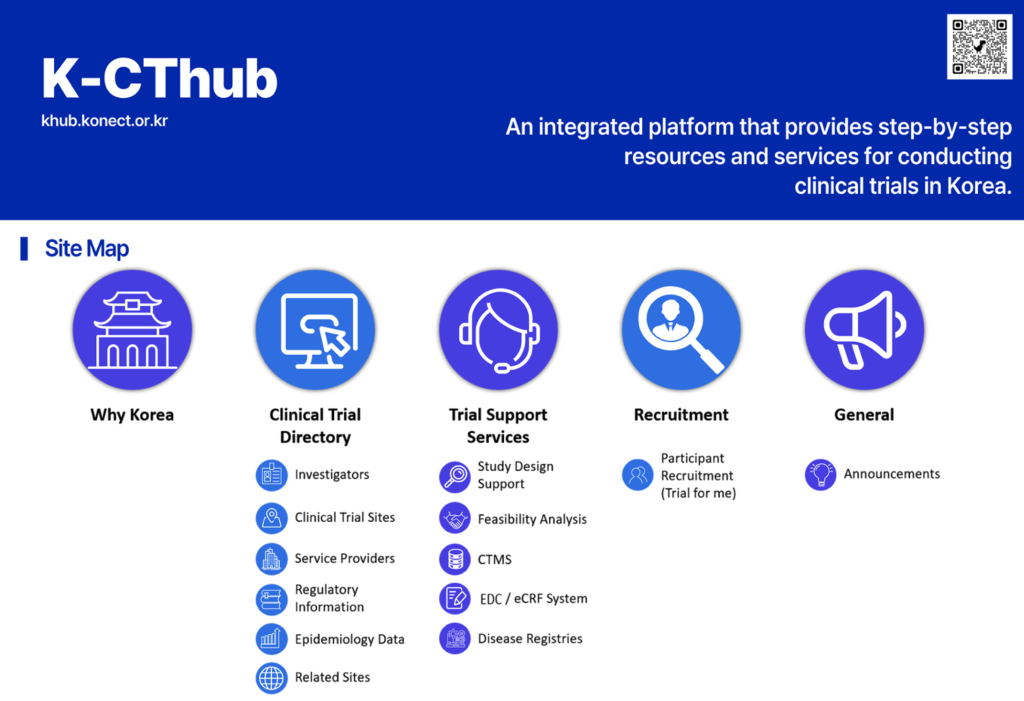
Korea is one of the few countries offering a fully integrated, bilingual, nationally supported clinical trial information system designed specifically for multinational use. And its scale reflects the size of Korea’s ecosystem: 747 MFDS-approved trials in 2024, over 200 designated institutions, more than 15,000 research professionals, and the third-largest R&D pipeline in the world with 3,386 active drug candidates. The country’s 2024 portfolio also included 324 Phase I industry-sponsored trials, 124 Phase II trials, and 210 Phase III trials, reflecting the breadth of Korea’s capabilities across every phase of development.
Why This Matters: Sponsors Need Countries That Reduce Risk
EFPIA’s findings show that the world’s bottleneck is no longer regulatory approval alone. It is operational uncertainty. Between 2018 and 2023, European enrollment declined despite increased global trial activity. Oncology timelines lengthened. Rare disease trial starts fell sharply. Diagnostics-dependent programs slowed under new regulations.
Korea has avoided these disruptions. MFDS timelines remain consistent. IRBs maintain predictable turnaround. Hospitals deliver strong throughput. And national digital health infrastructure provides reliable patient histories.
K-CThub strengthens these advantages by giving sponsors early, data-driven feasibility insight. Instead of relying on anecdotal experience or scattered regional sources, sponsors have immediate access to verified epidemiology, site capabilities, and investigator experience in one place.
For modern clinical development, predictability is becoming a competitive necessity.
How K-CThub Strengthens Feasibility Across Oncology and Chronic Diseases
Oncology remains Korea’s largest area of clinical research, with 276 MFDS-approved trials in 2024 and more than 100 early-phase studies. K-CThub allows sponsors to harness this depth by consolidating oncology-related epidemiology, site caseloads, investigator experience, and anticipated MFDS and IRB timelines into a single, structured view.
Through these integrated national resources, sponsors can assess potential recruitment pathways at the earliest stages of planning and identify institutions capable of supporting enrollment strategies with greater precision. K-CThub supports this ecosystem by enabling sponsors to review epidemiology, anticipate participant flow, and request customized recruitment services tailored to specific study needs.
But the platform’s value extends well beyond oncology. Korea’s competitiveness in clinical trials for chronic and metabolic diseases has been increasing steadily, supported by large patient populations, strong specialist networks, and consistent epidemiologic data. Through K-CThub’s feasibility service, sponsors can analyze disease prevalence, review institutional capacity for chronic disease trials, identify investigators with relevant experience, and compare sites based on past trial performance or population characteristics.
By unifying feasibility and epidemiology insights across therapeutic areas, K-CThub transforms early trial planning into a transparent, evidence-based process. Sponsors can explore the full potential of Korea’s research environment, whether planning high-complexity oncology programs or expanding into metabolic disorders, rare diseases, or long-term chronic disease studies.
“Our intention is to make K-CThub the official portal for planning and executing clinical trials in Korea. By integrating regulatory information, investigator data, feasibility resources, and AI driven support, we want to give global sponsors the clarity and efficiency they need to run trials with confidence.”
Closing Insight: Korea Built the System Others Are Still Planning
Global assessments show a global landscape where trial performance varies widely and operational reliability cannot be taken for granted. Many regions are pursuing digital modernization and infrastructure upgrades, but implementation often remains uneven, leaving sponsors with uncertainty during critical planning stages.
Korea has taken a coordinated, national approach to this challenge. Through sustained investment, regulatory consistency, and integrated digital systems, it offers an environment where feasibility, timelines, and operational expectations are aligned in ways that directly support global clinical development.
K-CThub brings these strengths together in a single, data-rich platform that provides visibility into feasibility, site capabilities, investigator experience, and potential patient availability long before first patient in. It allows sponsors to plan with a level of clarity that is increasingly rare in a world of rising complexity and tightening operational margins.
In this environment, Korea offers something essential to modern clinical development: confidence.
And confidence, more than speed or volume, is what determines where sponsors choose to conduct their most critical studies.
“Every clinical journey in Korea begins with K-CThub”
This article is Sponsored by KoNECT

Moe Alsumidaie, MBA, MSF, is founder and Chief Editor of Vanguard Publications, which publishes Clinical Trial Vanguard, Pharma Vanguard and BullScope, and Head of Research at CliniBiz. He has two decades in clinical trial operations and data science, with earlier roles at Genentech, Abbott Vascular and Stanford University Medical Center, and is a guest lecturer in clinical trial sciences at Rutgers University.