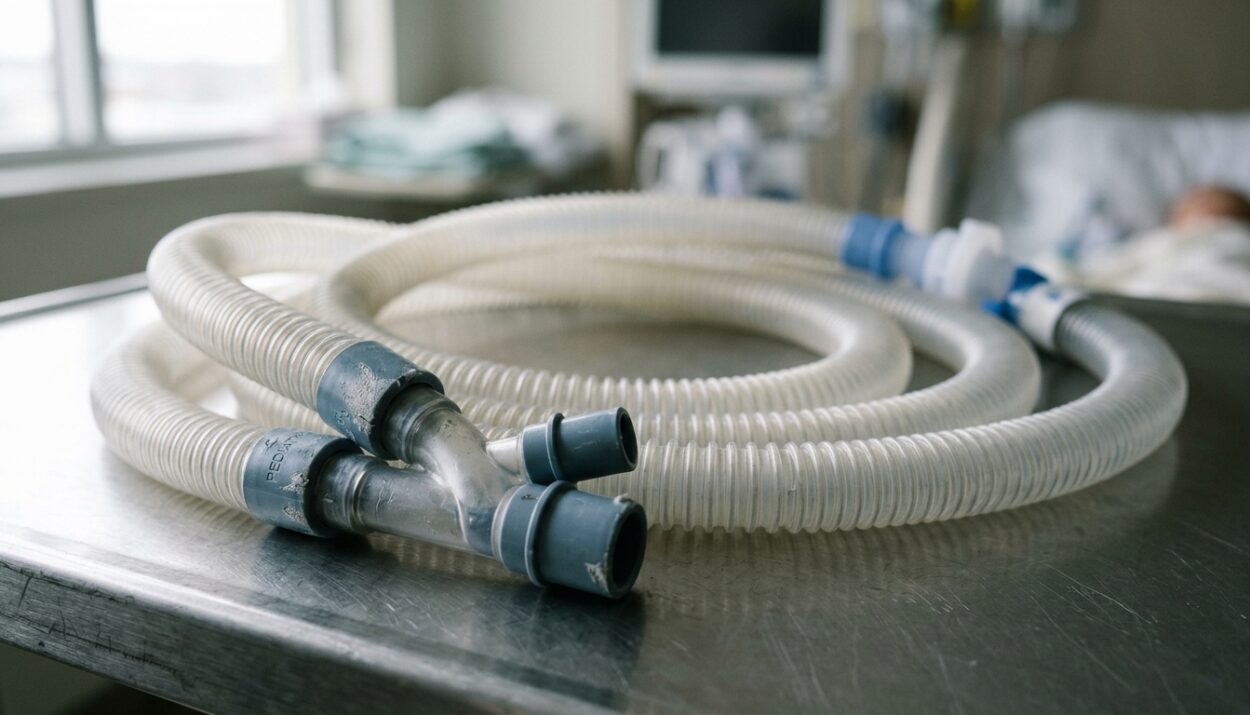

For years, pediatric intensivists flipped critically ill children onto their stomachs and dialed ventilators into high-frequency oscillatory mode with the conviction of people doing the right thing. The physiological rationale was sound. The adult data, particularly from the PROSEVA trial in 2013, was persuasive. And in the absence of rigorous pediatric-specific evidence, clinicians made the only defensible choice available to them: they borrowed from adults and hoped the biology translated.
It did not. Published today in The Lancet, the PROSpect trial, a two-by-two factorial, response-adaptive, Phase 3 randomized controlled trial conducted across multiple countries, found no evidence that prone positioning or high-frequency oscillatory ventilation (HFOV) improves ventilator-free days at 28 days in children with early, moderate-to-severe pediatric acute respiratory distress syndrome (PARDS). The routine use of both strategies is now, formally, not recommended. That verdict should land hard in any pediatric ICU that has treated these children under the assumption that the standard of care was actually supported by evidence.
The Machine Nobody Built for Children
The central insight PROSpect forces onto the table is structural: pediatric critical care has been running on extrapolation for decades. The meta-analysis of 11 studies and 2,605 HFOV cases that preceded PROSpect showed physiological improvement in oxygenation index, a number that looks good on a monitor but does not translate cleanly into survival or ventilator liberation at the population level. Clinicians read improving oxygenation as a signal of efficacy. Mechanically, they were not wrong. Clinically, the signal was misleading.
Here is the mechanism worth understanding: oxygenation index responds to HFOV because the continuous distending pressure recruits collapsed alveoli and reduces intrapulmonary shunting. Prone positioning works similarly, gravity redistributes perfusion toward better-ventilated lung regions, improving the ventilation-perfusion ratio. Both interventions change the numbers on the screen. But ventilator-free days at 28 days measure something categorically different: whether the child gets off the ventilator faster and stays off. A maneuver that improves oxygenation while adding sedation burden, circulatory instability, or complications that extend ICU dependency can produce a beautiful oxygenation curve and a worse outcome simultaneously. The PROSpect investigators measured the right endpoint. Their predecessors mostly measured proxies.
That distinction, surrogate endpoint versus patient-centered outcome, is the trial design lesson most coverage of PROSpect will skip past. In pediatric ARDS, the field spent years building clinical intuition around intermediate markers, and PROSpect is now demonstrating what happens when you finally ask the harder question with the rigor it deserves.
The two-by-two factorial structure amplifies this point. Sir Ronald Fisher introduced factorial design in 1935 precisely because it allows investigators to test multiple interventions simultaneously without multiplicative sample-size costs, while also detecting whether two treatments interact with each other in ways that neither alone would reveal. PROSpect deployed this structure to test prone positioning and HFOV as independent variables, meaning it could determine not only whether each intervention worked in isolation but whether combining them produced effects, synergistic or antagonistic, that a simpler two-arm trial would have missed entirely. That is not a methodological convenience. In a patient population where sample sizes are inherently constrained by disease incidence, it is close to the only ethical path to a definitive answer.
The response-adaptive randomization layer makes this more sophisticated still. Unlike fixed-allocation designs where each arm receives a predetermined fraction of participants regardless of accumulating data, response-adaptive randomization adjusts allocation probabilities as evidence accumulates during the trial. Arms showing early signs of harm or futility receive fewer patients. Arms showing preliminary benefit attract more. The practical consequence is that PROSpect could simultaneously pursue statistical rigor, protect enrolled children from inferior treatments in real time, and preserve the power needed to reach a definitive conclusion. These objectives are normally in tension with each other. The design resolved that tension rather than ignoring it.
What the Protocol Required, and Why That Is Uncomfortable
Negative results from well-powered trials are not failures. They are corrections, and corrections in pediatric critical care are desperately overdue.
Before PROSpect, prone positioning and HFOV were already embedded in many ICU protocols for PARDS, adopted from adult practice at a time when no adequately powered pediatric RCT existed to validate or refute them. That is a reasonable clinical posture in a data vacuum. But the vacuum persisted, in part, because pediatric trials are hard to fund, hard to enroll, and hard to power in rare, acute conditions where consent timelines are compressed and families are in crisis. The PROSpect investigators built a trial architecture specifically designed to work within those constraints, using factorial enrollment and adaptive allocation to extract more signal per enrolled patient than any conventional two-arm design could have achieved. The result took years and required international coordination. The question worth asking is why it took this long, and what other standard-of-care assumptions in pediatric critical care are still operating in the same evidentiary vacuum that HFOV and prone positioning occupied until today.
The meta-analysis of 11 HFOV studies covering 2,605 cases, published in Pediatric Critical Care Medicine and indexed at PubMed, showed mean oxygenation index improvements that looked clinically meaningful. A reasonable intensivist reading that evidence in recent years would have concluded that HFOV was probably beneficial. PROSpect did not prove that intensivist wrong, exactly. It proved that the question they were asking, does HFOV improve oxygenation in sick children, was the wrong question. The right question was always whether it got children off ventilators sooner without additional harm. Oxygenation index improvement without ventilator-free day benefit means the treatment is rearranging the physiology without changing the trajectory.
The Dissent Worth Hearing
The counterargument from experienced clinicians will be that PROSpect measured a population average and that individual patients, particularly those with the most severe disease and refractory hypoxemia, may still benefit from HFOV or prone positioning as rescue strategies when conventional ventilation fails. That argument has merit. Subgroup heterogeneity in adaptive trials is real, and a null result at the population level does not foreclose individualized clinical judgment in extremis. The PROSpect authors acknowledged this directly: their recommendation against routine use does not prohibit selective use in refractory cases where the risk-benefit calculus shifts. But the distinction between “routine first-line strategy” and “rescue consideration” is not semantic. It changes protocols, changes training, changes how the next generation of intensivists develops clinical intuition, and it is exactly the kind of distinction that only a well-designed, adequately powered RCT can establish with enough authority to move institutional practice.
The systemic insight here cuts beyond pediatric ARDS: clinical practice in low-incidence, high-acuity populations routinely runs years or decades ahead of its evidence base, sustained by physiological plausibility and borrowed data from adjacent populations. PROSpect demonstrates what it costs, in trial infrastructure, international coordination, and adaptive design complexity, to finally close that gap. The field should treat that cost as a benchmark, not an anomaly.
The next intensivist who reaches for the prone positioning protocol in a child with moderate PARDS will now do so knowing what the evidence actually says. That is not a small thing. That is what rigorous trial design, run with patience and methodological integrity, is supposed to produce, and what the pediatric critical care community has been owed for longer than it should have had to wait.
References
- The Lancet, “Prone positioning and high-frequency oscillatory ventilation in early paediatric acute respiratory distress syndrome (PROSpect): an international, two-by-two factorial, response-adaptive, phase 3, randomised controlled trial”
- PubMed, PROSpect trial primary reference, published October 31, 2026
- PMC, “Response-adaptive randomization in clinical trials: methodology and origins”
- PubMed, “High-frequency oscillatory ventilation in children: A systematic review and meta-analysis” (11 studies, 2,605 cases)
- Wikipedia, Factorial experiment design, tracing to Fisher’s The Design of Experiments (1935)
- Clinical Trial Vanguard, “When the Standard of Care Fails the Trial: What PROSpect’s Negative Findings Reveal About Pediatric Critical Care’s Evidence Crisis”

Moe Alsumidaie, MBA, MSF, is founder and Chief Editor of Vanguard Publications, which publishes Clinical Trial Vanguard, Pharma Vanguard and BullScope, and Head of Research at CliniBiz. He has two decades in clinical trial operations and data science, with earlier roles at Genentech, Abbott Vascular and Stanford University Medical Center, and is a guest lecturer in clinical trial sciences at Rutgers University.