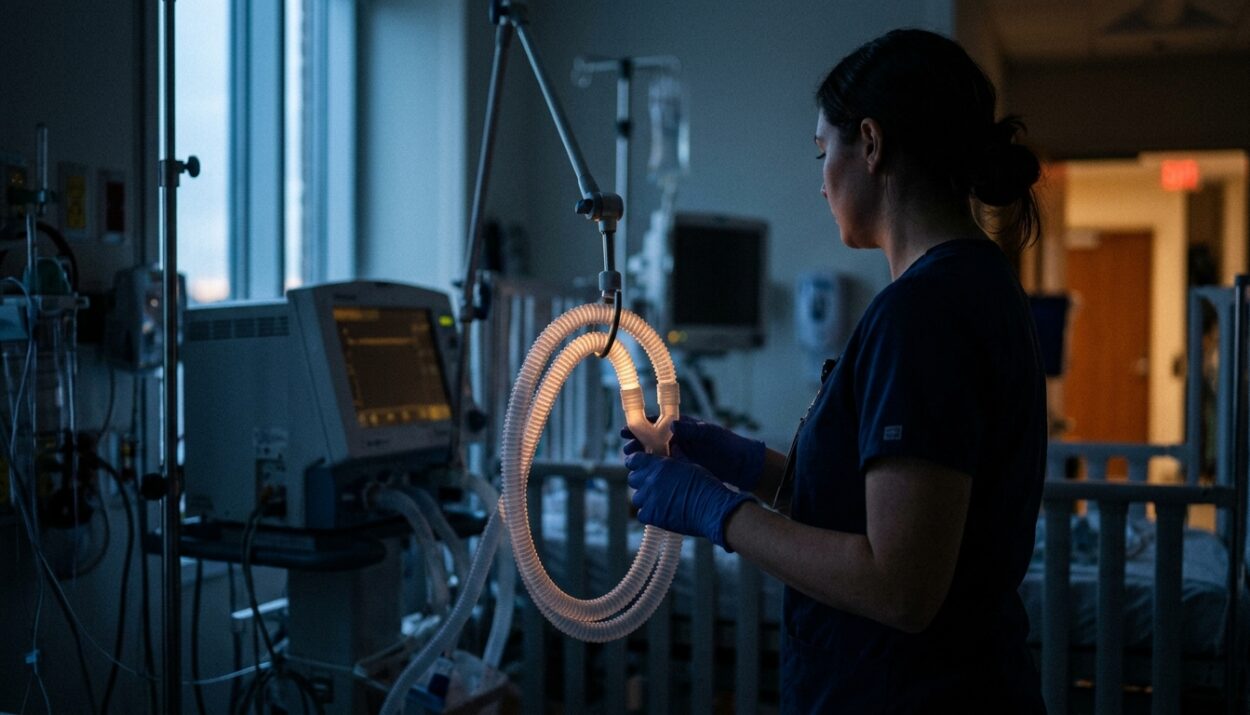

For years, pediatric intensivists have flipped critically ill children face-down and dialed up oscillatory ventilators, not because randomized evidence told them to, but because the logic was compelling and the alternatives felt worse. Prone positioning works in adult ARDS. High-frequency oscillatory ventilation looked promising in small studies. Children in moderate-to-severe respiratory failure are not a population where clinicians wait for certainty before acting. So practice spread, protocols embedded, and two interventions became near-standard in PICUs across the world without a phase 3 trial ever confirming they helped.
The PROSpect trial, published in The Lancet, just answered the question those years of practice never formally posed. In 424 children with early, moderate-to-severe pediatric acute respiratory distress syndrome (PARDS), prone positioning showed no evidence of improving ventilator-free days at 28 days. Neither did high-frequency oscillatory ventilation (HFOV). The trial’s conclusion: routine use of these strategies in this population is not recommended. That is the headline everyone is running.
But the headline misses the more important story.
The Trial Design Nobody Is Talking About
What PROSpect actually demonstrated, underneath the negative findings, is that a response-adaptive factorial design can generate definitive answers in a population where traditional randomized controlled trials almost never succeed. That is the non-obvious achievement here, and it matters far beyond pediatric critical care.
Running a phase 3 RCT in critically ill children is among the hardest operational problems in clinical research. The population is small, acutely ill, and heterogeneous. Parents must consent under duress. The intervention window is narrow, often hours. Sites vary enormously in standard-of-care practice. And the disease itself, PARDS, has multiple overlapping severity trajectories that confound simple two-arm comparisons. Every one of these factors has been used, at various points, to explain why high-quality evidence in pediatric critical care lags so far behind adult medicine.
PROSpect rejected that logic operationally. The trial enrolled 424 children across multiple international sites using a two-by-two factorial structure that tested prone positioning and HFOV simultaneously, not sequentially. The response-adaptive component allowed the trial to adjust allocation probabilities based on accumulating outcome data, steering enrollment toward the arms that were performing better in real time. That mechanism serves two purposes at once: it protects children enrolled later in the trial from inferior assignments, and it extracts more statistical signal from a limited population.
The result was a trial that answered two clinical questions in the time and sample size that a conventional design might have used to answer one. For a field that has spent decades citing population constraints as the reason evidence cannot be generated, that is a proof of concept as important as any efficacy finding.
Which raises the uncomfortable question that the “two treatments don’t work” narrative obscures: if the design was capable of detecting benefit when benefit existed, why has pediatric critical care waited this long to use it?
When Evidence Arrives After Practice Has Already Decided
The adult ARDS literature provides instructive context here. The Children’s Hospital of Philadelphia, one of PROSpect’s institutional stakeholders, noted that the trial’s findings effectively ruled out two interventions that had been used as first-line therapies in pediatric patients. “First-line” is the operative phrase. These were not experimental rescue maneuvers tried after standard care failed. They were embedded in front-line management, which means the clinical community spent years generating non-trial practice data for an intervention that a properly powered trial now says does not improve the primary outcome.
This is a structural problem in pediatric critical care that PROSpect illuminates without solving. Practice extrapolated from adult evidence. Small studies generated hypothesis-level signals that looked promising. Guidelines, written under pressure to say something actionable, incorporated those signals. And by the time a phase 3 trial was designed, the interventions had already achieved something close to standard-of-care status in many PICUs, which paradoxically makes enrollment harder because clinicians and families are reluctant to randomize away from what feels like established practice.
PROSpect overcame that reluctance well enough to enroll 424 children. That is not a small achievement.
The lesson for trial designers working in other small, high-acuity populations, including neonatal sepsis, pediatric CNS emergencies, and rare pediatric oncology indications, is that the response-adaptive factorial structure is not just a statistical nicety. It is the architecture that makes ethical randomization feasible when the patient population is too small to waste on sequential single-question trials and too vulnerable to leave randomized to an arm that interim data suggests is underperforming.
What Negative Results Actually Cost
There is a version of this story where PROSpect’s negative findings represent failure: years of multicenter coordination, international site management, and adaptive design infrastructure, all to confirm that two widely used interventions do not work. That reading is wrong, and it reflects a publication-bias instinct that has distorted clinical evidence for decades.
Knowing that prone positioning does not improve ventilator-free days at 28 days in children with early moderate-to-severe PARDS is worth exactly as much as knowing that it does. More, arguably, because false positives in clinical practice are harder to dislodge than true negatives. Once a therapy achieves routine use, the burden of proof to abandon it is far higher than the burden of proof that initially justified adopting it. PROSpect prevents that asymmetry from calcifying further.
Consider what the alternative looks like. Without a definitive trial, HFOV and prone positioning continue as standard practice in many PICUs for another decade, supported by observational data, physiologic rationale, and institutional inertia. A meta-analysis eventually signals inconsistency across sites. A guideline committee debates whether the evidence is strong enough to issue a recommendation either way. The field remains in the liminal state that pediatric critical care has occupied for years: too much practice, too little proof.
PROSpect closed that loop in 424 patients using a design that was sophisticated enough to be trustworthy and honest enough to publish a null result without burying it. The Lancet publication, on October 31, 2026, treats the negative finding as the finding, not as an embarrassment to be framed around, which is precisely the publication standard that makes evidence useful.
The PICU teams that read this trial and update their protocols have gained something concrete: permission to redirect clinical attention and research resources toward interventions that might actually move the needle in PARDS. The teams that dismiss the findings because they conflict with established practice will keep flipping children prone and reaching for oscillatory ventilators without a single randomized data point to justify it.
PROSpect did not just tell the field what does not work. It showed, with 424 children and a factorial adaptive design across international sites, exactly what it takes to get an honest answer in a population that clinical research has historically failed. The next trial in a small, critically ill pediatric population either uses this design template or explains, in the protocol, why it chose something less capable of delivering the truth.
References
- The Lancet, “Prone positioning and high-frequency oscillatory ventilation in early paediatric acute respiratory distress syndrome (PROSpect): an international, two-by-two factorial, response-adaptive, phase 3, randomised controlled trial”
- PubMed, PROSpect trial indexed record, PARDS prone positioning and HFOV phase 3 RCT
- Children’s Hospital of Philadelphia, “Study Rules Out Two First-Line Therapies for Pediatric Patients with Acute Respiratory Distress”

Moe Alsumidaie, MBA, MSF, is founder and Chief Editor of Vanguard Publications, which publishes Clinical Trial Vanguard, Pharma Vanguard and BullScope, and Head of Research at CliniBiz. He has two decades in clinical trial operations and data science, with earlier roles at Genentech, Abbott Vascular and Stanford University Medical Center, and is a guest lecturer in clinical trial sciences at Rutgers University.