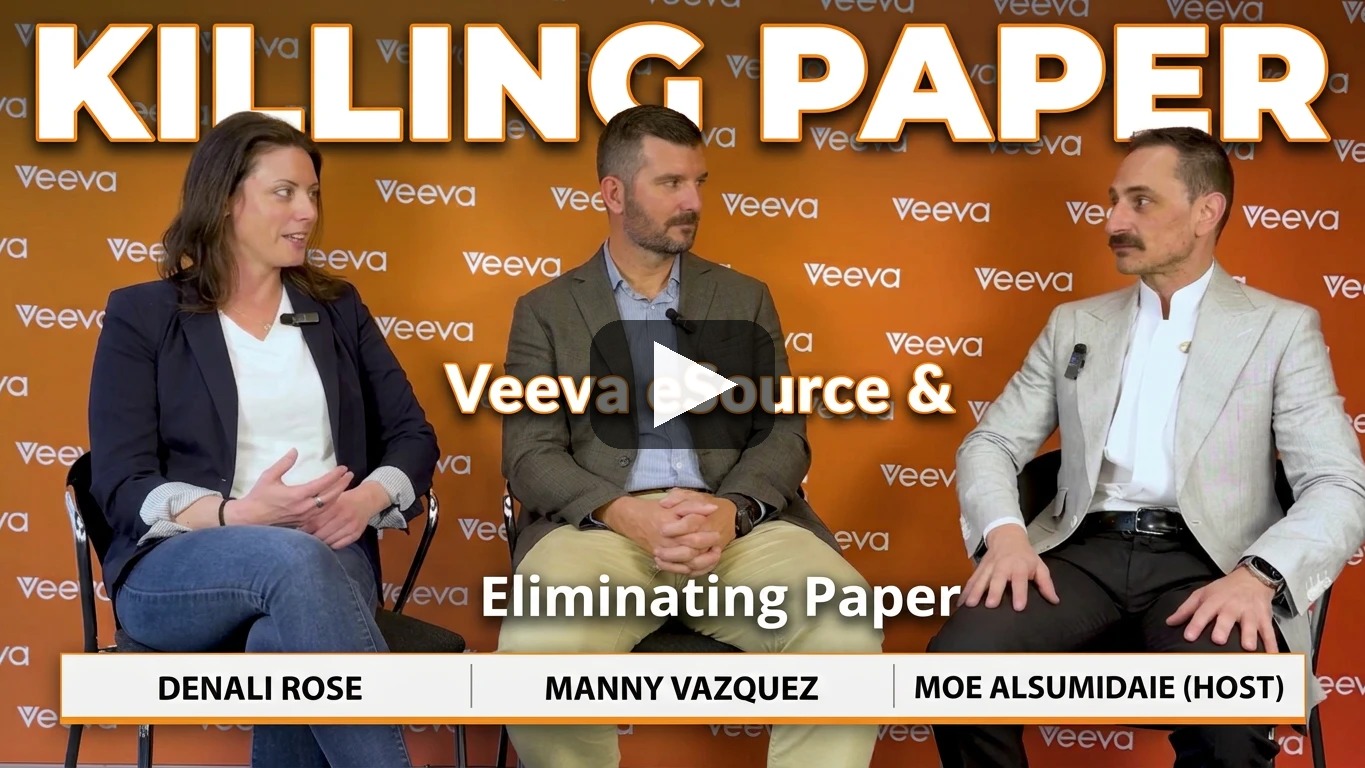
For two decades, the clinical research industry has promised that electronic source would liberate site coordinators from duplicate data entry. It hasn’t. Most eSource deployments simply swapped paper transcription for digital transcription: same burden, different screen. At the Veeva R&D and Quality Summit in Copenhagen, Manny Vazquez, Senior Director of Clinical Data Strategy, and Denali Rose, Vice President of Sales and Strategy, Site Solutions, sat down to explain why Veeva is approaching the problem differently this time. Their argument is structural: eSource only scales when the site owns it, operates it across their entire portfolio, and the data flows bidirectionally: not just into EDC, but back to the site when queries land. The product is still in development, with first releases expected by year-end, but the strategic logic behind it has implications for every sponsor still building site-burden reduction into their protocol assumptions.

Senior Director, Clinical Data Strategy, Veeva Systems
Moe: How can Veeva’s eSource strategy advance trial workflows, and what does it break in the old way of working?
Manny Vazquez: The old workflow was broken to begin with. We’re not breaking anything, we’re fixing issues that already exist. The ability for a coordinator at a research site to enter a data point once and have it go wherever it needs to go, whether that’s EDC, back to their EHR, or straight through to analysis datasets, just entering it once and being done would be a game changer in their current workflows.

Vice President, Sales and Strategy, Site Solutions, Veeva Systems
Denali Rose: The theory behind eSource has been around for a really long time, but it really just took paper and turned it into something electronic. There was no fundamental change for the site. In fact, it probably added some more work. There might have been some quality controls that helped, but from a site coordinator’s perspective, current-day eSource doesn’t actually provide much efficiency.
The big differentiator we’re looking at from a Veeva perspective is twofold. One, it’s a site-owned solution: they own it, they operate it, it is in their control for their entire portfolio. So they have a single way of working across studies, across sponsors. The other piece is the connectivity that Veeva eSource will have with EDC. It’s not just the flow of data, where you’re taking data from EHR and eSource to EDC, there’s workflow connectivity with it as well. Sponsors already know what data they want collected in their EDC, but having those CRFs flow to eSource means sites aren’t having to recreate those from scratch or do that study-specific eCRF build in their own system. They get that automatically. Then the data flows back to EDC, and queries come back to that eSource. So the site is operating in one system, in a streamlined way, for their workflows and their data.
“We’ve tried to solve site problems by saying here’s the technology, this is going to be great, and we just keep layering it on top. It just becomes a significant burden on the downstream.”
— Denali Rose
Moe: Why does site ownership, rather than sponsor imposition, change what eSource can actually deliver?
Manny: Sponsors historically have been blind to how sites capture source documentation. That’s probably been one of the key cruxes to this challenge for the last ten or fifteen years. Sponsors have tried, on a study-by-study basis, to impose electronic source tools on sites with no idea how sites are actually working. Sites have their own processes, their own SOPs. They are the responsible party when it comes to collecting source documentation.
Anytime a sponsor has historically imposed an eSource tool on a site for a specific study, all they’ve really done for the site is replace the EDC entry with the eSource entry, because the site’s workflow isn’t changing, and they’re still capturing the source document on paper. The way we’re going about it is more scalable in the sense that it is not a sponsor decision. Sponsors are the beneficiaries for sites that are choosing to do this for themselves. But it’s got to be the site who decides they are going to digitize their own process and build it into their workflow.
As far as the sponsor is concerned, it’s all direct data capture. Anything that comes through on the other side in EDC, they know it’s source. It gives them immediate visibility into the source data because it is source data, and they can immediately verify it for the same reason. We haven’t quantified it yet, but I think we can reasonably assume there will be significant cost savings in source data verification, because you wouldn’t have to do that for data that comes through this way.

Moe: How does the bidirectional query workflow handle a data entry error that makes it through to EDC?
Manny: Source data is not necessarily clean data. There’s still a need to review and have those types of checks built in. But that’s the beauty of the bidirectional capability: when data does push through to EDC, EDC is still going to do the checks and the validation. If it finds anything that requires a query, it will trigger it back, and the site will get that feedback in their eSource window. They can review what they put in, make an update and submit the correction. It’ll function very similarly to how they currently engage with EDC, but now they can do it all within a single user experience. There’s no need to source-verify it. Anything that comes through to EDC is by default source.
Denali: Having electronic source also means you’re not re-keying from your EHR. You just have less opportunity, by design, to key something in wrong. It’s one entry versus two. And there are checks you can build in: if something is ridiculously out of range, say you put in blood pressure 380 instead of 180, the system will flag it. So there are general quality controls compared to paper, where you can put anything down and then rekey it in. Those general collection best practices will increase quality overall. Although, as Manny said, source data isn’t clean data.
Moe: How does eSource change what site coordinators can actually do with their time?
Denali: The expectation is that when they go live on eSource, they get some of those efficiencies back. I think the reason a lot of sites are in this business is to take care of patients. That’s the boots-on-the-ground work. Any time you can give that time back to site staff, they can put it back into what matters most, which is doing the actual science and taking care of the patients.
I think about what we saw in the EHR space, where providers found the first wave of digital tools really tough, they were staring at computers. As the tools got better and better, they could pay more attention to patients. I would expect something similar in clinical trials, especially where patient retention is such a challenge. The more human we can be about it, the better retention rates can be. We need to get the technology out of the way of that and give them time back, not have the technology detract from it.
“It’s got to be the site who decides they are going to digitize their own process and build it into their workflow. Sponsors are the beneficiaries for sites that are choosing to do this for themselves.”
— Manny Vazquez
Moe: Why does waiting another year to implement eSource carry a real cost for sites and sponsors?
Denali: It comes back to what we talked about earlier: the time you get with your patients, the time you get to do science. The longer you wait, the less time you have with your patients and the less time to do why you’re doing research.
And I think it’s worth noting that for any site running under twenty-one trials, eSource is following the same model as SiteVault and CTMS: there’s no cost. So for those sites, there’s no barrier. They could do it now.
Manny: I’d agree with that. From a research site perspective, there was a barrier to entry for a long time: you need the manpower to implement something, the funds to afford a tool. As that becomes more accessible, for any technology, when the ability to be more efficient and remove paper becomes available, you really have to justify why you wouldn’t do that.
From a sponsor perspective, this is a site-driven change, and the value lands with sponsors as the beneficiary: reduced SDV, sites delivering data digitally, and what they could do with automation and AI built on top of that simply by having all the data digitized at the source. Even better if sponsors have site engagement teams willing to help sites along on the journey. I think it’s all upside from a sponsor perspective. We’d all love to see paper removed, transcription removed, and a fully end-to-end digital workflow so we can build the AI on top of it that we all know is coming.
Manny Vazquez is Senior Director, Clinical Data Strategy at Veeva Systems. Denali Rose is Vice President, Sales and Strategy, Site Solutions at Veeva Systems. Both were interviewed at the Veeva R&D and Quality Summit in Copenhagen.
This content is sponsored by Veeva Systems.

Moe Alsumidaie, MBA, MSF, is founder and Chief Editor of Vanguard Publications, which publishes Clinical Trial Vanguard, Pharma Vanguard and BullScope, and Head of Research at CliniBiz. He has two decades in clinical trial operations and data science, with earlier roles at Genentech, Abbott Vascular and Stanford University Medical Center, and is a guest lecturer in clinical trial sciences at Rutgers University.